Showing posts with label Books. Show all posts

Wednesday, September 17, 2014

Five Favorites

Today I'm stepping in for Heather and guest hosting Five Favorites. And my good friend Laura is stepping in for me with this guest post. If you've never visited her blog, get thyself over to This Felicitous Life. She covers topics profound and mundane, and it's always a great read. I promise.

So, without further ado, here's Laura.

Non-Conventional Book Club Picks

“Why have you put ‘Wine for Her?’” she asked. “What’s that supposed to mean?”

“It means that these are wines that women are more likely to enjoy,” said Bruce. . . .

“And why do you think women would want different wine from men? Do they have different taste buds?”

“Yes,” he said. “Women like sweeter wine. And they like bottles with more feminine labels. Everybody knows that.”

--Alexander McCall Smith, Espresso Tales


via
Books with "discussion questions" at the end strike me as the literary equivalent of a "Wines for Her" shelf. I feel condescended upon, stereotyped: Woman In A Book Club = chick who probably can't finish the book, much analyze it herself, and just shows up for the wine. Grrr.

That's not to say there aren't plenty of good books that have discussion questions at the end. Still, it's a strike against them to me.

In that spirit, here are five non-conventional book club picks that my book club and I have enjoyed over the years.

The Children of Men by P.D. James: Apocalyptic thriller, a real page turner. Chilling, yet completely non-religious, vision of a world that stops having children. Don't judge the book by the movie based on it, which is very different.

The Book of Judith (in the Catholic Bible): Many Bible verses used in honor of the Blessed Virgin are taken from this book. What you might not guess is that Judith was one badass chick, who uses questionable tactics to defend her people. This book raises some puzzling moral questions that are fascinating to discuss.

Blood Brothers: The Dramatic Story of a Palestinian Christian Working for Peace In Israel by Elias Chacour: A short, autobiographical account of a Melkite Catholic Archbishop, whose community was uprooted from their homeland when he was a child, during the founding of Israel. He weaves his story in with reflections on the Beatitudes and his own quest for peace between Jews and Palestinians.

The Next Step In the Dance by Tim Gautreaux: This book has lots of conventional chick-lit ingredients- -a good-hearted, hard-headed woman and the man who loves her. But it's a beautifully written, clear- eyed look at marriage (my previous review is here), in the Southern literary tradition, with some tall- tale elements thrown in. Delicious.

Emotional Vampires: Dealing With People Who Drain You Dry by Albert Bernstein: This is psychology/ self-help in a funny, helpful format. This should be required reading for everyone entering the workforce, but if you didn't read it then, read it in your book club!

Happy reading!

Thanks for joining us for Five Favorites again this week! Let's hear some of your favorites!


Wednesday, July 16, 2014

De Pomiane in Ten Minutes

Today I'm linking up with Jessica for What We're Reading Wednesday. The book? French Cooking in Ten Minutes: Adapting to the Rhythm of Modern Life by Edouard de Pomiane.

I love this little book, and I think that I would get along swimmingly with the author, were he still alive (sadly, he passed away over fifty years ago).  De Pomiane's writing style is conversational, yet clear, witty, yet kind. You feel he has faith in your taste and abilities, no matter how inexperienced you may be. While de Pomiane's background as a doctor and scientist is apparent in his methodical approach and his faith in process, he refuses to reduce cookery and consumption to cookery and consumption.


And that brings me to my favorite thing about this book. It's really about more than French cooking, and you can profit from it even if you never prepare a single recipe from it's pages. It's a reminder: that meals are for nourishment and delight, that anyone can cook, that life is beautiful. Let me share with you one of my favorite passages, where the author describes what one ought to do following the stress free, quick, and delicious meal one has just prepared and consumed:
Fill your cup with the hot coffee... Lean back in your armchair and put your feet up. Light a cigarette. Take a nice long puff, then blow the smoke to the ceiling. Enjoy the coffee's aroma, take a long sip. Close your eyes. Think about that second puff, that second sip - you're rich!
And if that is all a little too esoteric for you, here are a few concepts that make this book a practical gem.

Courses: At the time of publication (1930, but maybe still?), French habit was to compose each meal with four or five small courses. While I personally love meals that have courses, I don't serve them at my house. In my mind, courses equal waitstaff and chefs. De Pomiane outlines how the cook pressed for time can plan, prepare, and serve just such a meal with a minimum of difficulty.

Cooking Methods: De Pomiane outlines the basics. He lists three cooking methods that can be accomplished quickly, and explains a bit about what is happening and why. He gives the reader an understanding, rather than just a process. And this is his modus operandi throughout the book. I think most of us have had a sauce turn out lumpy or an egg curdle and turned to takeout none the wiser for our failure. None of that with the good monsieur. If you fail, there is a reason, and he does his best to make sure that you understand why.

The Master Recipe: I recommend reading the book from Introduction to finish, all the way through. De Pomiane doesn't designate it as such, but he often starts each section with a master recipe that can be used, built upon, or modified. The cook is an artist and masterpieces start with basics. I love this concept, because it gives the novice cook an invaluable starting point rather than a deluge of recipes that can't be remembered.

So there, I think you will love this book even if you don't particularly care for French cuisine or such foreign wonders as Honeycomb Tripe with Tomato Sauce or Breaded Pigs Ears. De Pomiane wouldn't judge you, for as he says, "If you're not convinced, do as you like. After all, that's the best way to enjoy what you're eating."


Wednesday, June 25, 2014

A Reading List

I was going to call this "A Summer Reading List," but then I realized that this will take me into fall and winter, most likely. So let's be real. I'm putting this list out there mainly for myself, because I always jot titles onto random scraps of paper, and then... Lose them.


Currently:
The 10 Habits of Happy Mothers (Meg Meeker)  (I'm almost finished with this one. It's a really easy read and refreshment for the weary mother.)
Basil Moreau Essential Writings
On the Road (Jack Kerouac, book club)

In Queue:
Bossy Pants (Tina Fey)
Dad Is Fat (Jim Gaffigan)
Man Repeller: Seeking Love. Finding Overalls. (Leandra Medine)

A Good Man is Hard to Find (Flannery O'Connor, book club)
Catcher in the Rye (J.D. Salinger, book club)
Following Polly (Karen Bergreen)
Rules of Civility (Amor Towles)

The Nesting Place: It Doesn't Have to Be Perfect to be Beautiful (Myquillyn Smith)
One Thousand Gifts: A Dare to Live Fully Right Where You Are (Ann Voskamp)
The Tipping Point (Malcolm Gladwell)
The Well-Trained Mind: A Guide to Classical Education at Home (Susan Wise Bauer and Jessie Wise)
French Cooking In Ten Minutes: Adapting to the Rhythm of Modern Life (Edouard de Pomiane)

Any title by Elizabeth Goudge

To Reread:
The Intellectual Life (A.G. Sertillanges)


What's on your reading list?


Thursday, May 1, 2014

Books and Culture With Laura

Of Books and Men
by Laura Scanlon

It’s what’s on the inside that counts. 

Don’t judge a book by its cover. 

Appearances are deceiving.

The Rosie Project by Graeme Simsion provides a delightful illustration of the truth behind these clichés. The book’s protagonist is Don Tillman, a brilliant but extremely awkward professor. Don, the book implies, has Asperger Syndrome but doesn’t know it.


If you or I were to meet Don, we probably wouldn’t like him much. He makes rude, inappropriate comments. He doesn’t laugh at other people’s jokes. He comes off as an argumentative know-it-all. He dresses funny.

Because he narrates the novel, however, we see Don for who he really is. We see his steady nature, his dedication, his capacity for love and self-sacrifice. We understand the logic behind his bizarre behavior. We understand why so many social mores elude him, and we ache at the pain he feels but doesn’t show.

A woman named Rosie enters Don’s world. She is intelligent and beautiful but not at all what Don imagined his ideal wife to be. She shakes up his world and he falls in love. (You’ve seen the basic plot line already in one or two or a dozen romantic comedies, but don’t let that deter you.)

We hope that Rose will look past the awkwardness and realize what a great guy Don is. We hope she learns to love him for who he is. (Hint: she does.)

The Rosie Project brought to mind a book I read a while ago, Marry Him: The Case for Settling for Mr. Good Enough, by Lori Gottlieb. (Checking it out from the library as a married woman was rather embarrassing for me. I suppose it would be embarrassing for a single woman as well. . . . It would be even more embarrassing for a man. It’s just an all-around embarrassingly-titled book, and the author got some flak for it. But I digress.) 


In Marry Him, the author recounts wasting her younger years in dating sexy, exciting, yet unsuitable men. She bypassed potential spouses who were steady, kind, and responsible because she focused on external qualities that, too late, she realized were not so important after all.

The “settling” that Ms. Gottlieb proposes does not entail resigning oneself to an unhappy marriage. Rather, it’s about looking past the exterior qualities that don’t last and focusing on the interior qualities that do. It is about Rosie learning to love Don, and vice versa.

While thinking about these books, I look over at the guy who is sitting next to me in bed playing Starcraft on his laptop. And I want to kick myself. So often I am blinded by the dirty socks on the floor and the [list of my husband’s annoying yet harmless proclivities that I shall not publicize]. In the day to day of marriage and parenting I look over (or worse, take for granted) my husband’s patience, his love, his work ethic, and the scores of other reasons he was a good catch.

Thank you, Mr. Simsion and Ms.Gottlieb, for two therapeutic kicks in the pants. And for making them so fun to read. 

Laura is a Catholic Christian, a mother, a part-time lawyer, and a recovering overthinker. She writes monthly here at Atelier on books and culture, and blogs regularly at This Felicitous Life.

Wednesday, April 30, 2014

A Beautiful Mess

I'm linking up today with the ever lovely Jessica for What We're Reading Wednesday.

I'm guessing that a lot of you blog readers out there are familiar with the blog A Beautiful Mess. But did you know that the great minds behind the blog, Elsie Larson and Emma Chapman, recently  released a book? I didn't, until I ran across it at the library this weekend. 

If you are a blogger or a photographer or an amateur photographer or an Instagrammer or just a person with eyes, check this book out! The book, A Beautiful Mess: Photo Idea Book,  is full of great tips and tricks to inspire and help you create beautiful and interesting images. I so wish I had this book when I first started my blog a year and  a half ago! Some of the tricks I've learned along the way, but I guarantee that this book has something to offer everyone, no matter how seasoned or green.


I haven't quite gotten through all of it, but I've already been motivated in a tangible way. In Chapter 6, "Capture Yourself," one of the inspiriting ideas is to do a Thirty-Day Self Portrait Challenge. It goes like this: 
  • Take thirty days of self-portraits.
  • The portraits have to be about you or show you in some way.
  • You must take the pictures yourself.
  • As you go, share your photos with a close friend, your spouse, or online via Facebook or your blog.
Does anybody want to join in the fun? I haven't decided yet whether I'll share daily or do more of a once a week dump, but here's the photo to kick off the challenge. 


I took it as soon as the idea struck me. It's five o'clock, and I'm just finishing dinner - you can see my everyday black apron. And I'm feeling just as disheveled as I look. No filter.

Let the games begin.

Wednesday, April 16, 2014

The Greenest Island

Today I'm linking up with Jessica for What We're Reading Wednesday. I've had quite a lot of duds in the book department lately, mainly because our local library doesn't have a huge selection and I go in blind, randomly grabbing things that look interesting.  Like this book, for example. I couldn't get past the first few chapters before I skipped to the end, where all of my worst suspicions were confirmed. So what am I saying? The plot was both repulsive (to me) and at the same time predictable. I should have known from the title. However, Laura has given me hope, and I plan to request some of the books she recommends.

Anyway, I don't have much time to pound out a post today, so I had better get to the point. Last night I read Paul Theroux's The Greenest Island in the bathtub. It's that quick. It's the story of a very young couple that steals away to Puerto Rico to hide an unplanned pregnancy. The plot plays out over the course of a suffocatingly hot summer in the early 1960's.


It was my first contact with Theroux's writing, and I liked his style. It was clear, and he simply articulates thoughts that I have found my own mind dancing around. For example, at one point the young protagonist is forced to put aside his dream to write and take a job at a local hotel. Theroux writes,
The money was enough to live on, not enough to free him. So the salary trapped him more completely than the fear of poverty had. The job became central, the only important thing; and his ambitions became local: to take a publico rather than a bus, to eat in a good restaurant rather than La Gloria, to drink rum instead of beer (my emphasis).
I get the feeling that Theroux was writing from a place of experience - a quick look at his bio reveals that he had a child which he gave up for adoption when he was in college. But how many of us have also experienced this reality? The friction between dreams and needs, fear and security, comfort and freedom. So what's the solution? Theroux doesn't really get there in this short story, and I don't think it's an easy one. Maybe the most important thing is to be reminded that the friction exists.

Monday, March 10, 2014

Books and Culture With Laura

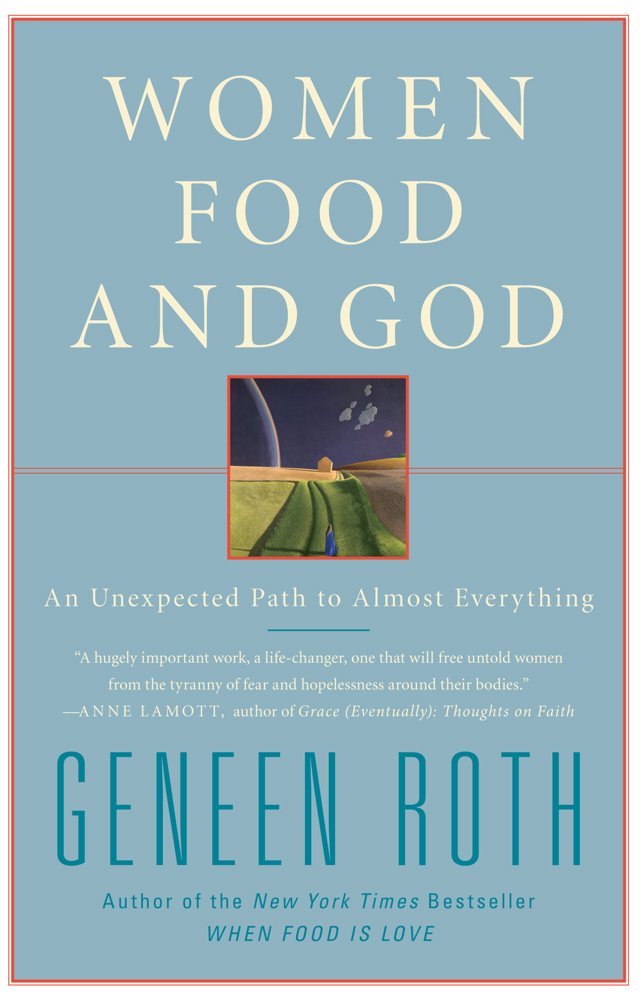
A Review: Women Food and God
by Laura Scanlon

I’ll start with the ending of Women Food and God, by Geneen Roth. Once a woman finds peace with food, the author proposes, a woman realizes that “God has been here. She is you.”


No . . . no. She’s not. That is to say, I’m not. Thanks all the same.

That being said: I found a lot of value in what Ms. Roth writes about women and food, even if I find the parts on God a bit lacking.

The author asks rhetorically, “What has hunger got to do with food?” For women who struggle with food obsessions (the author posits that over fifty percent of American women do), eating has everything to do with spiritual hunger but is unhealthily disconnected from physical hunger.

Ms. Roth explains that women overeat to distance themselves from their feelings and to seek happiness that eludes them elsewhere. “Women turn to food when they are not hungry because they are hungry for something they can’t name: a connection to what is beyond the concerns of daily life.” On the other extreme, some women diet compulsively seeking a sense of control and validation. “Diets are the outpicturing of your belief that you have to atone for being yourself to be worthy of existing.”

Both behavior patterns, the author explains, are forms of food obsessions and allow us to check out of life. “Obsession . . . creates a parallel world, a hologram of emotions . . . . There is madness in obsession, yes, but its value is that it drowns out the madness of life.”

Ending the obsession, according to Ms. Roth, comes through awareness: awareness of one’s feelings, of one’s true nature and, at the simplest level, one’s own body and sensations of hunger. In this regard, Women Food and God reminds me of French Women Don’t Get Fat, by Mireille Guiliano, and its motto of “pay attention.” The answer, according to Ms. Roth is to be aware and live fully the present moment you are in, no matter how mundane or unpleasant.

One of Ms. Roth’s illustrations on this point struck me: “If you focus on getting the dishes done so that your kitchen will be clean, you miss everything that happens between dirty and clean. . . . And when you miss those moments because you’d rather be doing something else, you are missing your own life.” There are plenty of kitchen- cleaning (and laundry folding and child-corralling) moments when I inhale a handful or three of M&Ms, or gobble the kids’ leftovers, even though I’m not the least bit hungry. Instead I eat to distract my senses from the drudgery, to avoid giving the task any more attention than absolutely necessary.

Moreover, the passage reminds me of a similar scene in One Thousand Gifts by Ann Voskamp. One Thousand Gifts does not address food compulsion at all and is explicitly Christian, as opposed to the Buddhist perspective of Women Food and God. Both books, however, address the authors’ grappling with emptiness and finding fulfillment through awareness and gratitude.
I wash dishes. . . . A soap bubble bursts next to my skin. A soap bubble, skin of light and water and space suspended in sphere. Who has time for that? . . . When I fully enter time’s swift current, enter into the current moment with the weight of all my attention, I slow the torrent with the weight of me all here. . . . I only live the full life when I live fully in the moment. . . . This is where God is.
Reading Women Food and God has challenged me to be more aware of each and every moment of my day, to practice gratitute for each moment, to discern true physical hunger and not abuse food as an anesthetic. I find these challenges especially suitable now, as Lent begins. While Women Food and God is not exactly Lenten spiritual reading (please understand I’m really not reviewing it to recommend it as spiritual reading) . . . I am grateful for the challenge.


Laura is a Catholic Christian, a mother, a part-time lawyer, and a recovering overthinker. She writes monthly here at Atelier on books and culture, and blogs regularly at This Felicitous Life. 

Thursday, February 27, 2014

How to Look Hot in a Minivan and Other Pressing Thoughts

Apparently that could be the title of this blog. Okay, not exactly, but Janice Min's "Real Woman's Guide"has the same driving idea behind it: Just because you have kids doesn't mean you can't be chic, and do so on a budget. And as a mom herself, Min espouses the idea that motherhood is both exquisitely beautiful and a life change that presents certain difficulties. Her message is to resist images of perfection and the other temptations to 'throw in the towel.'  By approaching your appearance with intentionality, you can be even an even "better" version of yourself after children.

How to Look Hot in a Minivan is basically a guide that covers what to expect postpartum, clothing, hair, makeup, and healthy living for the modern busy mama. The book is an easy read, perfect for skipping around to the areas that pique your interest. I would recommend borrowing it from the library rather than purchasing. It's fun, but I think that there are better resource books out there in most of the areas covered.

That being said, I did find the Introduction very interesting. Min spent six years at Us Weekly as editor-in-chief, and she comments on "the beginnings of a seismic cultural shift" that she and her colleagues were noticing (about 10 years ago). The cultural shift? The fact that many celebrities were not only pregnant, but flaunting it, and ushering in the age of the "momshell," the fashionable mom. Min points out that just ten years earlier even celebrities like Madonna avoided the limelight while pregnant. Now, high profile women were giving birth and then posing for bikini shots weeks later, apparently physically unaltered by the ordeal that is nine months of gestation and labor and delivery.


In this age of lower birthrates (and therefore a lower number of women who have experienced pregnancy, and even a lower number who have experienced multiple pregnancies), it seems to me that our culture tends to approach maternity in two contradictory ways. On one hand, it's portrayed as the end. The end of a desirable body. The end of being fit. The end of being anything other than saggy and lumpy and unattractive. And if one pregnancy doesn't do you in, several will ensure that your body is "ruined." In gestating, our bodies are destroyed in what is [at least implied to be] an unnatural state of things.

On the other hand, there is the cultural shift that Min mentions. A part of this shift is that pregnancy is portrayed as inconsequential in the physical sense. One should have a flat stomach weeks after giving birth. Not only will the weight come off immediately, pre-pregnancy jeans will come on immediately (wider hips who?). Anything less is unacceptable, and should be fixed.

I have experienced both of these contradictory attitudes to pregnancy, and strangely, sometimes even simultaneously.  As a person with body image issues in my past, my first pregnancy was plagued with apprehension. Would I immediately gain fifty pounds? Would I be covered in stretch marks? Would I be stuck with the pregnancy weight forever, even if I exercised and ate right? Basically, would my body be "ruined"?

After making it through the pregnancy with a healthy amount of weight gain, I was left with some stretch marks, and hips that were a bit wider, but all in all, intact. Better than intact. But I couldn't get my jeans on. And my stomach was soft, and rounded. I admit that I was discouraged and tempted to take some immediate food restriction measures even though I wasn't overweight and I was nursing. Thank goodness I have a really affirming husband, and an addiction to the Google, which informed me that it is normal for the uterus to take four weeks to return to its pre-pregnancy size.

What is the correct way to view pregnancy in this age of appearances and impossible expectations? That it is both radically natural and radically altering. The female body is equipped to get the job done, albeit with changes, some permanent, some temporary. A healthy view of the female body sees these changes as a normal part of life. I mean, what's the alternative? The end of the species?

The dichotomy between motherhood and being attractive is a false one. And it is just as false to portray motherhood as carrying no physical affects. But every body is going to age, and therefore change. At some point your bosoms will begin to sag a bit whether or not you have birthed a child. So, believe in your body, be good to yourself, and be not afraid!

Wednesday, February 19, 2014

What I'm Reading Wednesday

Are all of you out there familiar with Jessica's What We're Reading Wednesdays? If not, please head over and check it out. Reading is one of the great loves of my life, and one of my quandaries with blogging is that said activity cuts into reading time. So today, despite the fact that  many, many people are coming to my house this weekend (starting tomorrow at noon), I'm sitting here, reading. 

Currently on the docket are Sacred Marriage by Gary Thomas, and How to Look Hot in a Minivan by Janice Min. You don't have to say it, I'm a true renaissance woman, I know. I haven't finished either oeuvre - so I'll withhold any premature stamps of approval, but both are easy reading. 


What are you reading?

Thursday, February 13, 2014

Books and Culture With Laura

Uncomfortable Kisses From Katie
by Laura Scanlon

I’ve been reading Kisses for Katie. It’s an amazing memoir of a young woman named Katie Davis who, at eighteen years old, left a life of privilege in the United States to live in Uganda. Now in her early twenties, she calls Uganda her home, has founded a ministry there, and is in the process of adopting thirteen little girls. Thirteen!


Her story is amazing all right. But Katie Davis and I could never hang out.

She makes a commitment to be “Mommy” to these little girls. She does this without knowing how she will support them, while still promising her parents to come back to the United States, while still in a relationship with her boyfriend back in the States.

Katie writes about letting Jesus in and having her heart explode.
Just reading her story makes my head explode.

She makes me uncomfortable.

John Paul II once told a group of young people, “You were not made for comfort.”

Oh, but Your Holiness, you don’t know me personally. I am made for comfort! Really I am.

My current state in life gives me an out. I certainly can’t leave my own little girls and pack up and head to Uganda. Whether or not I’ve been entirely brave up until now, my calling for the time being is clear enough.

But it’s easy for me to get comfortable and justify it. I “need” to sleep in frequently so I’m not grumpy with my family. I “need” a comfortable house in which to care for them. I “need” coffee and chocolate and dinners out. I “need” a nice new purse. I need a nice life, dang it!

I’m not entirely ashamed of my comforts. Especially not the sleep.

But thanks to Katie Davis, now I’m just a bit uncomfortable.


Laura is a Catholic Christian, a mother, a part-time lawyer, and a recovering overthinker. She writes monthly here at Atelier on books and culture, and blogs regularly at This Felicitous Life. 

Thursday, January 30, 2014

Books and Culture with Laura

An American Schlump Tries Parisian Chic On For Size
by Laura Scanlon

Encouraged by Lessons From Madame Chic, I recently picked up Parisian Chic: A Style Guide by Ines de la Fressange. The author - France’s self-proclaimed icon of chic - promises, “You don’t need to be born in Paris to have Parisian style.”


When I was growing up in the 1990s in the Deep South, style was simple: shoes match purse; fingernail polish matches toenail polish matches lipstick; earrings match necklace; necklace matches dress, dress matches eyeshadow.

So this idea of Parisian chic intrigues me but is more than a little foreign.

The author insists, “Don’t go for the head-to-toe! . . . We are all just steps from a fashion faux pas but the true Parisian will find a way to snatch a triomphe de style from the jaws of disaster.”

But how? Often enough, my outfits approach the jaws of disaster and then jump right in.

I read on, hoping for enlightening details:

• “Effortless style’ often takes, as it says, relatively little effort. All you really need is loads of self-confidence and a smile.”

So far so good. But . . .

• “Appearing to try too hard is very uncool: everyone knows the Parisian buys truckloads of fashion magazines to keep abreast of current trends, but she never lets it show!”

I don’t know, that sounds like effort to me!

• One basic is a “man’s blazer.” “Belt it,” the author says, and wear with jeans.

Like this:


Hmm:


I think I’m missing something.

The photos in this book make one lesson very clear: To look Parisian, try to be tall, thin, sixteen, with great hair, and high cheekbones.


Well, I’ll work on it. In the mean time, the author says to wear . . .

• “A parka over a little chiffon dress,”
• “Knee-high cashmere socks in all colors (khaki, raspberry, turquoise),”
• “Military medals and badges in place of a brooch,”
• “Your teenage son’s shirt with a push-up bra underneath,” but not
“cropped t-shirts,” or “too-tight shirts that gape,”
• Penny loafers, which are “absolutely essential” to the Parisian’s shoe
collection. “Team with chunky socks and jeans just short of your ankle.” 

Check! I’ve done that last one!

Kind of:


• Another staple is a navy sweater. “Understated, but more sophisticated than a plain black sweater. (Admit it: sometimes black sweaters are just too easy!)”

So . . . “effortless” is good, but “too easy” is bad. I’m confused.

• Navy blue is “risk free.”

Phew! I’m glad something is . . . .

• “Unless you wear it with yellow (in which case you are sailing dangerously close to the band colors of a certain Swedish furniture store).”

Well, drat, there goes my favorite outfit. Ikea, here I come.

Perhaps I should stop poring over the text and simply use the illustrations for guidance. 

Chic?


Hmm. Not so chic.


I give up, Ms. Fressange! I think you Frenchwomen really do have a certain je ne sais quoi that we Americans can never attain.

And perhaps that’s the whole point?


Laura is a Catholic Christian, a mother, a part-time lawyer, and a recovering overthinker. She writes monthly here at Atelier on books and culture, and blogs regularly at This Felicitous Life. 


Tuesday, November 5, 2013

Books and Culture with Laura

Gravity and Special Effects As Art
by Laura Scanlon

My ideal movie includes (A) British accents, (B) long skirts, and (C) marriage proposals. At least that’s my husband’s surmisal. I like to think that these elements simply happen to pop up frequently in the films sought out by those with sophisticated taste.

My husband, on the other hand, goes for science fiction, explosions, and car chases.

When we went to see Gravity, then, it seemed to more likely to be enjoyable for him. But it captivated both of us, and perhaps me the most. I gasped and clutched my seat as the camera first panned to show the Earth as seen from space, the black vastness of the universe beyond, and the characters, so tiny and vulnerable, floating between them.


I tend to think of special effects and a good plot to be mutually exclusive. Special effects, it seems, are inserted by movie makers too lazy to craft a good story, for movie watchers too dumb to appreciate one.

In Gravity, though, special effects blend seamlessly with the story and the characters. The special effects allow you to feel as though you are sharing Sandra Bullock’s harrowing ordeal and experience with her the depths of her loneliness. And for the height-averse like me, the movie instills a fervent desire never, ever, to leave one’s own beloved stratosphere.

What’s more, though, I think the special effects are the story. More than plot or character, the movie communicates the beauty of the earth, the grandeur of the universe, the fragility and preciousness of human life.

For I will behold thy heavens, the works of thy fingers: the moon and the stars which thou hast founded. What is man that thou art mindful of him? or the son of man that thou visitest him? (Ps. 8:4-5)

I’m no philosopher, but I’m quite sure that’s good art.


Laura is a Catholic Christian, a mother, a part-time lawyer, and a recovering overthinker. She writes monthly here at Atelier on books and culture, and blogs regularly at This Felicitous Life. 

Tuesday, October 1, 2013

Books and Culture


Lessons From Madame Chic: A Review
by Laura Scanlon


Not long ago, on a whim, I read Lessons From Madame Chic, by Jennifer L. Scott. On the surface, it's a fluffy chick-lit, self-help sort of thing. It was literary eye candy that caught my eye when I saw it on the library shelf. The author describes lessons she learned while living as an exchange student in Paris, in the household of an aristocratic, middle-aged, French lady, whom she dubs "Madame Chic."

As I read the book I realized that its themes--the hallmarks of French chic as the author describes them--are many of the things I have been striving for lately (and I suspect I'm not alone in my striving):

  • Creating a classic, stylish, minimalist wardrobe;
  • Eating delicious foods in an utterly satisfying yet temperate way;
  • Enjoying beautiful things while rejecting materialism;
  • Maintaining a beautiful, clutter-free home;

 And most of all:

  • Creating a routine to one's life—or even just a rhythm--and enjoying the peace that comes with it.

As the mother of young children, most days I feel that I battle entropy with every breath.

Simplicity? Elegance? Peace? Order? Oui, s'il vous plait! I’ll take some of what Madame Chic over there has.
....

As I think over this purported "French" way of life and the attraction I feel to it, I wonder: does this comport with the Christian life? Or is it all hedonism--the "museum life," as Jennifer Fulwiler describes it?

On the one hand, there is virtue, to be sure, to realize that one isn't in control of one's life, to accept the chaos and clutter and know that one has to let go and let God and what have you. At the same time, I’m quite positive that simplicity, order, and temperance are beneficial to a virtuous life. And surely God's command to fill the earth and subdue it includes bringing order to one's own little corner of the earth?

....

Certainly, not every "lesson" from Madame Chic is profound. And no one point in this book is really new. It is but one in a long line of books riding the recent wave of Francophilia among American readers (though it is my favorite of those that I have read). Nevertheless, it's remarkable to read one fluffy little book and find that it describes so much worth striving for. And the whole point of the book is that these objects of my striving are obtainable.

I am encouraged.


Laura is a Catholic Christian, a mother, a part-time lawyer, and a recovering overthinker. She writes monthly here at Atelier on books and culture, and blogs regularly at This Felicitous Life. 


Monday, July 29, 2013

Guest Post: Laura on The Truth About Style


Hello, readers! I don't know if you have missed me as much as I have missed you, but I'm back from Ertel wedding #2 of the summer, and ready to blog! I didn't want to go cold turkey for another whole week like last time, but my best laid plans were thwarted by away from home internet issues. Such is life.

Be that as it may (correct use of that expression? I don't know.), I will catch you up with a Weekend Diaries post in the next couple of days, and treat you to a guest post from my friend Laura today. If you don't read Laura's humorous and intelligent musings over at This Felicitous Life, well, you are missing out! Here is one of my fave posts. Now, without further ado - Laura!

Watching The Learning Channel’s “What Not To Wear” is a little luxury I look forward to whenever I stay in a hotel, as I don’t have cable at home.  The show offers me hope that style can be logical and learnable, not a just secret code known only to a few. The show promises that, with a little guidance, confidence, and a wrap dress, even the shabbiest caterpillar can transform into a butterfly. Sadly, the series enters its last season this year, but the legacy lives on with co-host Stacy London’s new book, The Truth About Style.


The book is a worthwhile read for anyone interested in developing their personal style and especially for those who, like me, ponder why one’s personal style matters . . . and whether it should.  Ms. London profiles nine women of different ages, sizes, and walks of life, each of whom is caught in a self-acknowledged style rut.  Ms. London addresses not only what these ladies should wear.  She also delves into the why behind the disconnect between their true selves and the images they project.  This approach is interesting but, to be honest, the makeovers themselves offer little that can’t be found in the dozens of similar personal style guides out there.  (In fact, I prefer Dress Your Best, a book that Ms. London and her WNTW co-host, Clinton Kelly co-authored in 2005, for nuts and bolts dressing well for your body type.)

The opening chapters of The Truth About Style, however, give it an edge over other style makeover books.  Ms. London majored in philosophy as an undergraduate, and it shows.  What is style?  How is it different than fashion?  Why does it matter?  Should it matter?  Ms. London addresses all of these issues.

In the opening chapter she posits, “[T]he uncomfortable truth is that appearances do matter.  Refusing to acknowledge that how you dress sends a message to other people is a major blind spot.”  Achieving this, Ms. London advises, requires “an unbiased, dispassionate acceptance of who you are, where your body is right now . . . and what your life circumstances are.”  She continues, “You must accept the good, the bad, and the ugly, without prejudice . . . just pure dispassionate observation.”  Style “is about enhancing who you are, and not attempting to look like someone you’ll never be.”  “Our clothes,” she says, “give other people insight into who we are.  To take control of the message, you have to know yourself, and dress accordingly.”

This concept of style and self-acceptance really resonates with me.  Reaching my thirties has given me a degree of self-knowledge--of being comfortable in my own skin-- that I never had before.  I like some aspects of myself (both physical and spiritual); others I still want to change.  But I finally get who I am.  Understanding oneself is one thing, however; dressing like oneself does not come automatically. Old habits die hard.  Overcoming them takes some work.  But it’s work worth doing.  As Ms. London acknowledges, style is “not as important as a friend you can trust, or your family, or doing what you love.”  Nonetheless, “style is a large part of what we see in the mirror and how we feel about ourselves. . . . . Everyone deserves to dress well and fell damn good about it.”

Sing it, sister!  Count me in!


Wednesday, December 12, 2012

A Book for Break

The other day I was adding labels to previous posts, and I realized that I haven't thrown that many book titles your way. I must rectify this situation immediately! I've picked three titles to share with you, keeping in mind that many of my readers are just finishing up finals and heading home for the winter holiday. In my mind, nothing is more necessary to a nice, cozy, and relaxing holiday than an easy read. So let us begin.

The first book is Emma Brown. This novel, based on an unfinished manuscript by Charlotte Bronte, was completed in 2003 by Irish author Clare Boylan. The story centers around young Matilda, a girl mysteriously without origin, identity, and family. The reader is taken on a whirlwind of plot turns and unexpected secrets until Matilda's past and true identity are discovered. I found this book to be a truly melodramatic page turner - a real "chic flick" of a book!

{source}

The second book is Return to Paris: A Memoir with Recipes by Colette Rossant. In this delightful little book, Colette tells the story of leaving Egypt as a teenager and going to live with her French grandmother in the foreign world that was 1940's Paris. If you have a fascination with Egypt, France, post-WWII Europe, and / or good food, you will love this book!

{source}

The third and final offering I have for you today is quite possibly my favorite fiction of the last two years - The History of Love by Nicole Krauss. Ah, where to begin in describing this book... Maybe I should take the easy way out and hope that my fervent endorsement and the title alone will move you to read this book. If not, go here to read a well put summary of this complex and compelling work. As an aside: I have not read Krauss' debut, A Man Walks Into a Room, but let me assure you that this recommendation is nothing like her third, Great House. I found Great House to be all of the complexity, struggle, and pain with none of the humor, hope, and redemption that is the hallmark of The History of Love.

{source}

If you have read any of these works, or do so at my recommendation, drop me a line and share your thoughts!

Wednesday, September 26, 2012

From the Library

Before delving into today's topic, I'd like to issue an internet acknowledgement and thanks to little H for helping with yesterday's pictures (I usually give her a credit shot at the end but I was short on time). She  has come a long way in her three weeks of picture taking. I'm glad because I really want to keep her on staff. There are certain benefits to having a three foot tall three year old taking your photo, not the least of which is a great angle that makes one look super tall and the fact that she works for marshmallows.

On to more relevant things... In keeping with the idea that I am sharing things with you good readers that I enjoyed and think my sisters would enjoy, I have a couple casual reads to throw out there. I'm not saying that you should hop over to Amazon at once and purchase these, just check them out (pun) at your local library. In preface I say that these aren't among the great literary works of all time; they are, however, fun, a bit practical, and a good way to spend a lazy afternoon or evening. So, if you are all caught up on the latest First Things, check these out!


Parisian Chic: A Style Guide by Ines de la Fressange (2011). Ines, the face of Chanel in the 80's, is now a business woman, designer, and still occasional haute couture model (yes, you did your math correctly, she is in her fifties). This fun little read is peppered with Ines' own illustrations and fashion, beauty, and lifestyle tips on how French women achieve that je ne sais que.  There is also a section on where to go in Paris (a girl can dream, right?). 

Style A to Zoe: The Art of Fashion, Beauty, & Everything Glamour (2007), by Rachel Zoe. Rachel Zoe is an American stylist to the stars and consultant for Piperlime and Gap, Inc. In her book, Rachel conveys her personal philosophy on how to live glamorously via biographical stories, contributing experts and her own [for the most part] practical advice on everything from how to pose for flattering pics to how to pack a suitcase.

Ines and Rachel couldn't differ more in their backgrounds or appearance, but they both put forth a philosophy that any woman can be glamorous and chic, and that it doesn't have to cost tons of money. With a little ingenuity, attention to detail, and confidence, any woman can bring more beauty and joy into the everyday.

All this talk of a Frenchwoman and a Californian reminds me, don't forget to enter the Frenchy of California Giveaway. Six days left!