Showing posts with label Food. Show all posts

Friday, September 5, 2014

It's Hot But I'm Still Hungry

And my garden has 100 ripe tomatoes. 

Or so it seems.

I want to share with you this super easy and quick recipe. It's my simple version of pasta caprese.


Easy Pasta Caprese

Ingredients:

Two or Three Large Tomatoes
Generous Handful of Basil
3/4 - 1 lb. Pasta (prepared and at room temperature; I prefer the "bite size" shapes to spaghetti or fettucini, but anything works)
8 oz Mozzarella Ball
Juice of 1 Lemon
Olive Oil 
Salt and Pepper

As you can see, the ingredient list is simple, and the amounts flexible. It's really whatever your taste dictates.

Wash the basil leaves by placing them in a bowl of water and swishing around. Pull them out and if there is sediment in the water, replace the water and repeat. Do this until there is no more dirt in the water (this method is really the most thorough for anything leafy - lettuce, parsley, mint, etc, etc... nothing spoils a meal like a mouthful of grit). Place leaves on a towel to dry.

Roughly chop the tomatoes and mozzarella into bite size pieces. Throw them into a large bowl. Gently rip the basil with your fingers and throw into the same bowl. Add the lemon juice and about 1/3 cup of olive oil. Mix.

Add in the prepared pasta. Season with salt and pepper. Serve with bread for getting those tasty juices at the bottom of the bowl.

And an ice cold hard cider or a glass of chilled, dry white wine and you have the perfect dinner to beat the heat! Enjoy!


Wednesday, July 16, 2014

De Pomiane in Ten Minutes

Today I'm linking up with Jessica for What We're Reading Wednesday. The book? French Cooking in Ten Minutes: Adapting to the Rhythm of Modern Life by Edouard de Pomiane.

I love this little book, and I think that I would get along swimmingly with the author, were he still alive (sadly, he passed away over fifty years ago).  De Pomiane's writing style is conversational, yet clear, witty, yet kind. You feel he has faith in your taste and abilities, no matter how inexperienced you may be. While de Pomiane's background as a doctor and scientist is apparent in his methodical approach and his faith in process, he refuses to reduce cookery and consumption to cookery and consumption.


And that brings me to my favorite thing about this book. It's really about more than French cooking, and you can profit from it even if you never prepare a single recipe from it's pages. It's a reminder: that meals are for nourishment and delight, that anyone can cook, that life is beautiful. Let me share with you one of my favorite passages, where the author describes what one ought to do following the stress free, quick, and delicious meal one has just prepared and consumed:
Fill your cup with the hot coffee... Lean back in your armchair and put your feet up. Light a cigarette. Take a nice long puff, then blow the smoke to the ceiling. Enjoy the coffee's aroma, take a long sip. Close your eyes. Think about that second puff, that second sip - you're rich!
And if that is all a little too esoteric for you, here are a few concepts that make this book a practical gem.

Courses: At the time of publication (1930, but maybe still?), French habit was to compose each meal with four or five small courses. While I personally love meals that have courses, I don't serve them at my house. In my mind, courses equal waitstaff and chefs. De Pomiane outlines how the cook pressed for time can plan, prepare, and serve just such a meal with a minimum of difficulty.

Cooking Methods: De Pomiane outlines the basics. He lists three cooking methods that can be accomplished quickly, and explains a bit about what is happening and why. He gives the reader an understanding, rather than just a process. And this is his modus operandi throughout the book. I think most of us have had a sauce turn out lumpy or an egg curdle and turned to takeout none the wiser for our failure. None of that with the good monsieur. If you fail, there is a reason, and he does his best to make sure that you understand why.

The Master Recipe: I recommend reading the book from Introduction to finish, all the way through. De Pomiane doesn't designate it as such, but he often starts each section with a master recipe that can be used, built upon, or modified. The cook is an artist and masterpieces start with basics. I love this concept, because it gives the novice cook an invaluable starting point rather than a deluge of recipes that can't be remembered.

So there, I think you will love this book even if you don't particularly care for French cuisine or such foreign wonders as Honeycomb Tripe with Tomato Sauce or Breaded Pigs Ears. De Pomiane wouldn't judge you, for as he says, "If you're not convinced, do as you like. After all, that's the best way to enjoy what you're eating."


Friday, April 25, 2014

Lentils and Rice

or Imjaddrah ma' Roz

But you can just call it lentils and rice. As I've mentioned before on Instagram, if I don't get dinner started by a certain time, it's really difficult to make it happen. The baby has a wakeful time during the late afternoon and through the evening, and it's hit or miss with the others. They might play in peace or hang on my heels and whine. 

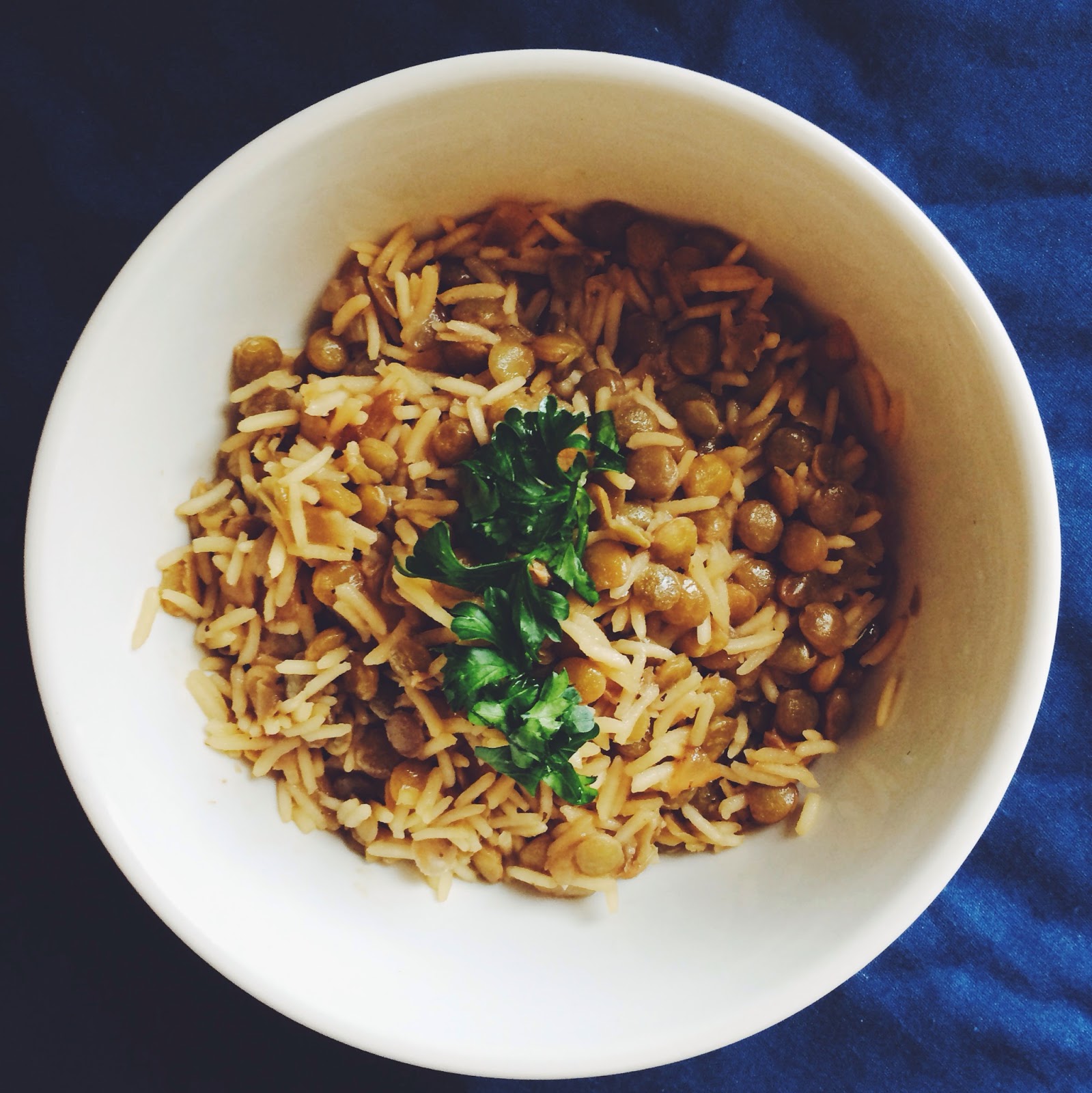
Yesterday, I realized that it was 4:30 and no dinner was started and the troops were grouchy. So I made lentils and rice. I'm going to share this recipe with you because it is so very quick, easy, cheap, healthy, and best of all, really quite delicious!  This recipe is modified from this book, which I've mentioned previously.

Any rice will do, but basmati tastes great and is as cheap as the cheap stuff if bought in bulk.
And look at this reusable bag! It even has a zipper at the top!

The final product, garnished with a sprig of parsley.


Ingredients:
1 Cup Lentils
4 Cups Water
1 Large Onion (or 2 small ones)
1/4 Cup Oil
1 Cup Rice
1 1/2 tsp. Salt
1/4 tsp. Pepper

Rinse the lentils and pick out any impurities.

Place the beans in a medium saucepan with 4 cups of water, bring to a boil, and then reduce the heat. Simmer for 20 minutes.

While the lentils simmer, heat the olive oil in a Dutch oven over medium high heat.

As the oil heats up, quickly dice the onion (perfection not necessary).

Saute onion in the oil until golden brown, stirring occasionally.

Add 1/4 cup of water to the onions and mash them lightly with a potato masher.

Add in the lentils, water and all.

Then add the rice, salt and pepper. Turn the heat to low and simmer, uncovered, until water has evaporated and rice is tender, about 15 minutes. Enjoy!

We also had a small chunk of feta in the fridge, a few scallions and some tomatoes that needed to be used. So I crumbled the feta on a plate and topped it with two diced Romas and a handful of chopped scallions. I finished it with a drizzle of olive oil, a generous shake of oregano, and a grind of salt... Yum! All credit to my husband for that little recipe!


Wednesday, April 2, 2014

Midweek Munchies: Lemon Popcorn

At some point at the beginning of dating my now husband we had a conversation that went something like this:
Me: I really like popcorn. 
Husband: Me, too. How much do you like it? Like you could eat a whole bag? 
Me: Yeah... I really like it. I could probably eat a whole bag.  
Husband: I really like it, too. I can eat a whole bag. 
Me: Yeah.. I might be able to eat more than a whole bag. 
Husband: More than a bag? Like two bags? 
Me: Okay, I can eat two bags. 
Husband: Me, too.
Suffice it to say, we love popcorn. Thank goodness it is so healthy with all of its fiber and antioxidants and whatnot! I want to share with you one our favorite ways to eat it, which was taught to me by my good friend, Ana. If you are skeptical of this recipe, please promise me you will try it at least once. Promise?! You won't be disappointed.


Ingredients:
Popcorn (microwaved or stove popped with a bit of olive oil)
Lemon Juice (fresh squeezed or from the bottle)
Seasoned Salt (we use a generic brand, just look for one that doesn't contain MSG)

Put one serving of popped corn into your bowl. Sprinkle 1 1/2 tsp of lemon juice over the bowl, making sure not to dump too much in any one area. Sprinkle with seasoned salt to taste. Enjoy!


One final note: I highly recommend purchasing a Whirly Pop if you make a lot of stovetop popcorn. It can't be beat! Also, I happen to know this great family that grows small batches of non-GMO corn just for popping. You can order their products online, and the gift sets make great, you guessed it, gifts! 


Monday, March 17, 2014

Happy St. Patrick's Day!

Due to certain circumstances, we celebrated St. Paddy's Day as a family yesterday. So, I just wanted to take a minute and recommend to you this incredibly easy and fast soda bread recipe


I know it's sort of last minute, so you might not have buttermilk on hand (I didn't, and rarely do). If that's the case, all you need is regular milk and white vinegar or lemon juice to make your own. For our loaf, I used whole milk and lemon juice. I also baked ours in the Dutch oven for 35 minutes and not a minute longer, and it was perfect. Enjoy!


Monday, March 10, 2014

Books and Culture With Laura

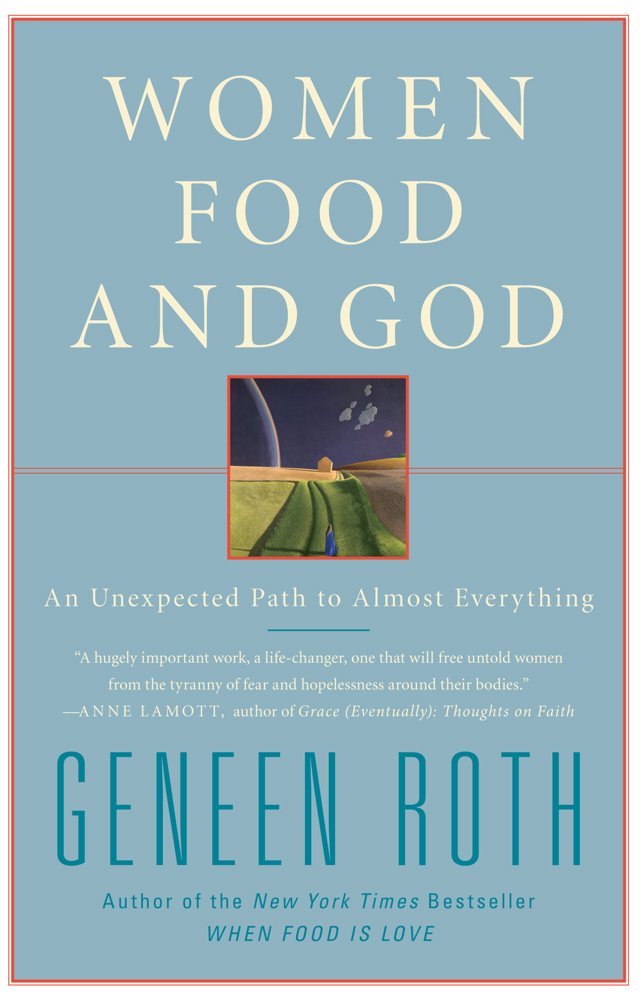
A Review: Women Food and God
by Laura Scanlon

I’ll start with the ending of Women Food and God, by Geneen Roth. Once a woman finds peace with food, the author proposes, a woman realizes that “God has been here. She is you.”


No . . . no. She’s not. That is to say, I’m not. Thanks all the same.

That being said: I found a lot of value in what Ms. Roth writes about women and food, even if I find the parts on God a bit lacking.

The author asks rhetorically, “What has hunger got to do with food?” For women who struggle with food obsessions (the author posits that over fifty percent of American women do), eating has everything to do with spiritual hunger but is unhealthily disconnected from physical hunger.

Ms. Roth explains that women overeat to distance themselves from their feelings and to seek happiness that eludes them elsewhere. “Women turn to food when they are not hungry because they are hungry for something they can’t name: a connection to what is beyond the concerns of daily life.” On the other extreme, some women diet compulsively seeking a sense of control and validation. “Diets are the outpicturing of your belief that you have to atone for being yourself to be worthy of existing.”

Both behavior patterns, the author explains, are forms of food obsessions and allow us to check out of life. “Obsession . . . creates a parallel world, a hologram of emotions . . . . There is madness in obsession, yes, but its value is that it drowns out the madness of life.”

Ending the obsession, according to Ms. Roth, comes through awareness: awareness of one’s feelings, of one’s true nature and, at the simplest level, one’s own body and sensations of hunger. In this regard, Women Food and God reminds me of French Women Don’t Get Fat, by Mireille Guiliano, and its motto of “pay attention.” The answer, according to Ms. Roth is to be aware and live fully the present moment you are in, no matter how mundane or unpleasant.

One of Ms. Roth’s illustrations on this point struck me: “If you focus on getting the dishes done so that your kitchen will be clean, you miss everything that happens between dirty and clean. . . . And when you miss those moments because you’d rather be doing something else, you are missing your own life.” There are plenty of kitchen- cleaning (and laundry folding and child-corralling) moments when I inhale a handful or three of M&Ms, or gobble the kids’ leftovers, even though I’m not the least bit hungry. Instead I eat to distract my senses from the drudgery, to avoid giving the task any more attention than absolutely necessary.

Moreover, the passage reminds me of a similar scene in One Thousand Gifts by Ann Voskamp. One Thousand Gifts does not address food compulsion at all and is explicitly Christian, as opposed to the Buddhist perspective of Women Food and God. Both books, however, address the authors’ grappling with emptiness and finding fulfillment through awareness and gratitude.
I wash dishes. . . . A soap bubble bursts next to my skin. A soap bubble, skin of light and water and space suspended in sphere. Who has time for that? . . . When I fully enter time’s swift current, enter into the current moment with the weight of all my attention, I slow the torrent with the weight of me all here. . . . I only live the full life when I live fully in the moment. . . . This is where God is.
Reading Women Food and God has challenged me to be more aware of each and every moment of my day, to practice gratitute for each moment, to discern true physical hunger and not abuse food as an anesthetic. I find these challenges especially suitable now, as Lent begins. While Women Food and God is not exactly Lenten spiritual reading (please understand I’m really not reviewing it to recommend it as spiritual reading) . . . I am grateful for the challenge.


Laura is a Catholic Christian, a mother, a part-time lawyer, and a recovering overthinker. She writes monthly here at Atelier on books and culture, and blogs regularly at This Felicitous Life

Tuesday, March 4, 2014

My Husband Cooks Better Than I Do and Roasted Red Pepper Hummus

When my husband and I got married six years ago, we both enjoyed good food, but we had very different ways of eating on a daily basis. I grew up in the home of an excellent cook and a meat and potatoes and vegetable man, but throughout college I didn't do much cooking or much meat eating. I was pretty poor (and busy) in school, and I ate very simply - beans and nuts, cheaper in-season fruits and vegetables. Any extra money I had I chose to spend on coffee, alcohol, and cigarettes (Don't judge. I also ran three at least miles day. Now it's been years since I've smoked. Or run.).

The husband, on the other hand, is a really great cook. By the time we started dating he was on his second masters degree, and was past the point of a peanut butter subsistence diet. He had a ridiculously productive garden, he cooked regularly (without using recipes, no less, gasp!), and he would often host elaborate Sunday dinners for large groups of friends, displaying his knowledge of various cuisines. No pressure, newlywed Mary, no pressure. Right.

Now, add into that equation the fact that, because of his father, many of my husband's favorite foods were things I had maybe tried once or twice or never.  His father, who is from Cairo and lived awhile in Lebanon, is also an excellent cook, and can make the simplest dish of lentils and macaroni (I kid you not) taste amazing. Amazing. Now we're talking tabouleh, kibbee, lubee, fettoush?! I was beginning to feel like my husband should have married someone else...

But my husband is a smart one, or tricky, I'm not sure... Guess what he did? At first he made all of these dishes and got me hooked. Then he taught me how to make them with him. Then, casually, he started requesting them when he wouldn't be around to help, so I would have to tackle things alone. And guess what? Now, six years later, I can make some damn good fettoush and tabouleh! Need stuffed grape leaves to feed fifty? I'm your girl!

Today I want to share with you a Lenten favorite at our house -  hummus. It's a dish that has really crossed over into mainstream cuisine, but many have never made it at home. If you like hummus, and you are buying it pre-made from the store, stop! Its so quick and easy to do at home (and much less expensive, because a bottle of tahini really lasts).

The recipe we use is slightly modified from the book Kibbe 'N' Spice and Everything Nice (this cookbook is great for all, including the completely uninitiated).

Dog-earred.

Ingredients:
15 oz can chickpeas (aka garbanzo beans)
1 clove garlic
juice of two lemons
3 Tablespoons of tahini (sesame seed paste, found at many grocery stores)
1/2 teaspoon salt 
1/4 cup roasted red peppers (in winter I use canned in oil, but they are easy to roast using the broiler)

Dump contents of chickpea can into pot. Place on stovetop and cook at medium-high heat for about 5 minutes (to soften). Drain and reserve liquid. Let beans cool. Place cool beans into blender or food processor, along with garlic (peeled and sliced), lemon juice, tahini (make sure to stir first, as the oil separates out naturally), red peppers, and salt. Add part of the reserved liquid. Blend until smooth, adding more of the liquid gradually to achieve desired consistency. Go slow with this, because its harder to fix "too runny" than to prevent it. If it does get too runny (it happens to the best of us), you can add more garbanzo beans or even some great northern beans.

Drizzle with oil and serve with cut vegetables (carrots, celery, peppers, cucumbers) or pita bread. 

Enjoy!